The Press News is your distinct blog which brings the news to your smart devices. Trending issues on politics, entertainment, education, security and defence, economy, agriculture, community life, sports and a whole lot of other endeavours are here for you to enjoy. Do stay put!
Information is the oxygen that drives our daily interactions. If you are not informed then you will be surely informed. The Press News presents to you timely info and update and gist about the issues and happenings in Nigeria and all over the world. Our boundaries transcends Entertainment, politics, Education, Crime and Society, love and beauty and that which meet your needs. Stay updated and remain with the Press News…
-Editor
Be yourself; Everyone else is already taken.
— Oscar Wilde.
This is the first post on my new blog. I’m just getting this new blog going, so stay tuned for more. Subscribe below to get notified when I post new updates.
The Governor of Borno State, Engineer Babagana Umara Zulum has reopened Government Secondary school, Chibok for academic activities after being closed for seven years. The Governor made this known on Tuesday 8th June, 2021 via his verified Facebook page. In his post, he said that, “after 7 years of closure, I have today reopen the Government Secondary school Chibok were 276 school girls were abducted on the 14th of April, 2014”. This development has added another feather to the achievements of the professor Governor of Borno State who has continued to display competency in ensuring that Borno State reclaims it’s slogan as the home of peace. The Governor further said that, “we will never allow that unfortunate incident or something similar to that weaken our determination towards providing free and compulsory education to each and every child in our dear state”. It could be recalled that the dreaded Boko Haram terrorist group who launched a political Jihad in the Northeast part of Nigeria as far back as 2009, abducted 275 students of Government Girls Secondary school, Chibok in 2014. The students were preparing for their senior secondary school examination when they were abducted from their dormitory. The attack drew widespread condemnation and international campaign tagged #BringBackOurGirls, calling for the unconditional release of the girls held captive by Boko Haram. The incident is a pointer to the mission of Boko Haram which can be translated as “education is a sin” according to their ideology. However, due to the effort of the current government in Nigeria, a large percentage of the girls have been released while others still remain in captivity. The reopening of the school by the Governor following the upgrade of it structures has rekindled the hopes and aspirations of thousands of girls who seek a brighter future through education. The reopening ceremony was attended by the Minister, Ministry of Women Affairs, Same Pauline Tallen who was on ground to boost the morale of the school girls. The new structure of the school is circumferenced with a perimeter fence. Similarly, to ensure further security of the students, the Governor said that, “for now, the school will be operating as a day school and not as a boarding “.
Photos from the reopening ceremony attended by the Honourable Minister of Women Affairs, Dame Pauline Tallen
The management of Ahmadu Bello University, Zaria has perfected plans to organise Post-UTME Screening for candidates seeking admission into the university located in Zaria, Kaduna State, Nigeria.
This was made known in a Press statement signed by the Director, Public Affairs Directorate of the university, Malam Auwalu Umar and made available to newsmen and other concerned stakeholders on Monday 17th May, 2021.
It can be deduced that the delay in the conduct of the screening exercise was as a result of the Covid-19 pandemic which affected the education sector in the country which caused a distortion in the institution’s academic calendar for 2019/2020 academic session. It was gathered that the university is currently in her first semester of the 2019/2020 academic session due to the adoption of a segmented batch resumption for Students of the institution. The revised academic calendar was adopted to prevent the spread of Covid-19 among the members of the university community.
The Director, Public Affairs further stated that the admission exercise for the 2020/2021 and 2021/2022 academic sessions will be merged. This indicates that 2020/2021 academic session will be cancelled as a result of the vacuum created by the corona virus pandemic.
The management called on candidates, parents, and guardians to continue exercising patience and await further information on the conduct of the Post-UTME Screening exercise from the institution.
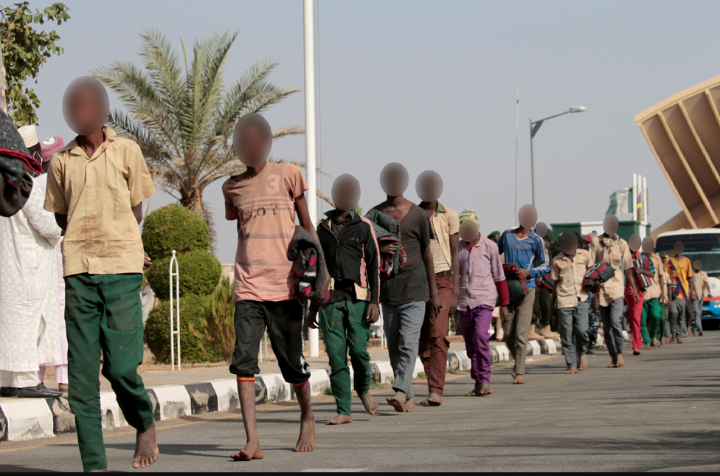
The circumstances surrounding the recent abduction and subsequent release of 344 school boys from Government Science Secondary school, Kankara in Katsina state have not only exposed the breach and mistrust in our security system as a nation, but have equally presented to us another highly sophisticated terror group. The operations of which are allied to the dreaded Boko Haram terrorist group
The released Kankara school boys being received in the Katsina state government house
It should be put on record that top on the agenda and priorities of any responsible government is the protection of life and property of her citizens. This can be visible by ensuring a peaceful environment to facilitate other rights and privileges of her citizens such as the right to education. Furthermore, to ensure a peaceful atmosphere, government have been saddled with the supreme power of monopoly of use of force to counter any attempt of internal insurrection or external aggression. The aim is to ensure the security of her citizens as the primary responsibility.
In the light of the foregoing, when a legitimate government attempt to (or) negotiate with criminals and terrorist who comes under different guise, it portrays nothing other than an acceptance of failure in their primary responsibility of protection of life and property. It further goes to show that the monopoly of the use of force have been taken away from the government.
As disappointed as we are as citizens of Nigeria, we continue to live in constant fear of the unknown. The scenario of those vibrant Nigerian children who have been made to go through hardship from no any other crime but as a result of their desire to acquire education. Their goal is to contribute in building their communities. Our fears have further been ignited due to the coordinated nature of the attack on the school and the strong ties shared between bandits in the North-West and Boko Haram in North-East Nigeria.
In essence, the twilight of Boko Haram insurgency in the North-East have given birth and snowballed into a gory wave of Armed Banditry, Cattle rustling, kidnapping, killing and wanton loosing of hell on communities in the states of Katsina, Zamfara, Kaduna, and in short, all the states of Northern Nigeria.
Taking a closer lense at the abduction of the school boys; a conspiracy theory will be discovered aside what the government and the military feeds us through the media. It has left some questions on the lips of Nigerians which are yet to be answered. Let us not forget that a military operation code-named “Sharan-Daji” have been on the watch to dislodge bandits and other criminal elements from their hideouts in forest of the North-Western part of the country since the last 3 to 4 years.
How possible is the abduction of 344 school boys to have taken place and transported to a forest in Zango/Paula in Neighbouring Zamfara State without being sighted by locals and even intercepted by our security forces especially with the story that the boys were transported on motorbikes? This is a question that demands an answer.
Similarly, media reports have it that the bandits were sponsored and the abduction was orchestrated to embarrass the President, Muhammadu Buhari who was on a week-long vacation in his home state. What is stopping the security agencies from apprehending the Kingpin of the attack and their alleged sponsors if they actually exists, remains a nightmare to me and others who share same opinion.
Furthermore, the abduction and subsequent release portrays that the bandits have advanced and grown in strength. They have also developed their link with Boko Haram which was evident in the video released by the dreaded terrorist group a day before the release of the boys. This shows that the bandits are no longer mere criminals but terrorist, towing with Nigerian sovereign National security.
Alot of information remains undisclosed by the government on the demand of the abductors and the subsequent ransom paid for the release of boys. Although, Governor Aminu Masari of Katsina State claimed that, they entered negotiation with the abductors but no ransom was paid before the release of the boys. Indeed, this is hard to believe.
The released Kankara school boys during their address by President Muhammadu Buhari in Katsina state government house
It is pertinent to rekindle here that negotiating with criminals portrays an acceptance of failure. Permit me to equally ask whether the kidnapping and their prompt release was stage managed to show the power of the military or the activeness of government and (or) to further demand for more funding and allocation for defence?
The constant attacks on our educational facilities pose a threat to the education of the Northern Child. Those who choose to go to school live in constant fear not knowing where is the next target for the insurgents. The gory tale of attacks on educational facilities was unveiled by the dreaded Boko Haram insurgent group in February 2014 when over 50 male students were killed in their dormitory in Government Secondary school, Buni-Yade, Yobe State. The campaign for the education of the Northern girl child suffered a big blow with the kidnap of over 200 Chibok school girls in Borno State in April 2014 of which many still remain in captivity. Although the veracity of Dapchi School girls kidnap in 2018, comes with some question tags, it exposed the weaknesses of our security system. In another way round, the strength of the terrorist who despite being defeated tactically in the words of the Information Minister, Lai Muhammed continues to wage a campaign of terror on poor Nigerians living in Northern villages.
When we were trying to breath a sigh a relief, comes the Kankara boys abduction taking the insurgents campaign against the Northern Child education to the next level. This attack have rekindle in bad light the unending insurgency in Northern Nigeria. It can be likened to a circular horizon which never ends but rather being capitalised as a venture for profit making while the poor masses suffers the brunt in the hands of Bandits.
It is high time the State and federal government wake up to their statutory responsibility. Let them take cue from how insecurity in other advanced country of which we copy our democracy from always puts the nation’s sovereignty and interest first when it comes to issues of National security. The government must stop paying lip service to the fight against insecurity if truly the promise of ending insurgency and all other forms of criminality is genuine. With peace we can achieve a virile Nigeria.
After the creation of Adam and Eve that happened to be the first beings created by God in heaven, their first test was through food (when they were cajoled by Satan and eaten the forbidden fruits); this signifies the antediluvian of human development which began with agriculture.
Agriculture has been the major backbone of global economy for decades; it has retained its pertinence of providing foods, shelter and other essential supplies for millions of people and therefore without it we would not be alive today. The agricultural sector has been the source of Nigeria’s income before the coming of colonial masters; sadly it was later given less priority following the discovery of crude oil in 1956 and hence became necessary for Nigeria to import some foods. Agriculture involves the cultivation of crops for either personal or commercial purposes and rearing of domestic animals for own use or profit; thereby agriculture supports the growth of agro-allied industries by providing raw and perishable products to them.
The agriculture in Nigeria today is one of the good businesses to invest; infact there are lots of business opportunities in agricultural sector. It provides a great source of income to many today; as a matter of fact many entrepreneurs are now taking farming venture to a higher level. Meanwhile, farmers are face with various challenges from feeding an expanding global population to meeting rising demands which involves producing more foods on lesser acres to the detriment of using less arable land, producing high quality and bountiful yields, rearing healthy and numerous animals for personal or financial security purposes. Nevertheless, the fertile Nigerian land has all it takes and provides all these and much more to the tireless farmers that have taken farming as indubitable, noble and vital profession. Farm produce are usually left to waste in remote areas where there are high rate of insecurity especially in the North-Eastern part of Nigeria, example was the recent massacre of farmers in Zabarmari of Borno state has thrown uncertainties in the minds of other farmers.
Agricultural businesses have been sustaining youths with employment but the problem is that government is not checking whether loans and finance it gives to youths are fully utilize. Agricultural activities also contribute to an improved system of food security and sustainable food production, as well as income for majority of people living in rural. Increased in prices of food commodities made people residing in towns to engage in farming mostly for consumption. However such activities increase the emission of greenhouse gasses and contribute to global warming which is why innovation is important in the sector so as to address such problems. For many years, Nigeria has been blessed with talented persons that could innovate some of the machineries imported from other countries but passiveness of governments in encouraging them are not supporting them financially or otherwise stunted them.
Despite huge amount set annually for the sector, yet there are numerous challenges bedeviling its progress; those problems that are hindering development in the sector includes diversion of funds and reduction of said financial support to farmers, lack of modern facilities and negligence of government to buy and offer subsidy for their prices, passive supervisory bodies on funds and items given to youths, etc Similarly, agriculture serves as the main source of raw materials for almost all companies. It could be cotton, sugar, wood, sugarcane or palm oil all are gotten from the sector. Unarguably raw materials are so important in the production process; they act like life to a body without which nothing would function. Some cultivate crops purposely for exporting; this is because there are no industries here that are producing goods from such raw materials. Agriculture therefore plays the role of a father who meets the demands of family members.
Perturbingly, agricultural sector is one of the most important which employs around 70% of Nigerian labour force but unfortunately government’s laxity in acquiring modern agricultural machineries, it makes youths migrate from rural areas to cities in search of a greener pastures therefore making agriculture in villages worthless which at the end reduces outputs. Secondly, government’s lackadaisity in funding and encouraging home developed agricultural devices; there are gifted engineers that could construct all kinds of farming tools and devices that are brought from abroad but governments on their part are not supporting them by sponsoring their works or encouraging them which could inspire them to put more efforts. Thirdly, deep down in hamlets there are thousands of farmers that are not aware of mechanize farming or new methods for bumper harvest therefore they are still stick to their archaic farm practices.
In the first republic i.e. in 1963, governments at all levels intensified efforts in funding and subsidizing all necessary inputs like pesticides, herbicides, fertilizer, etc to farmers which yielded positive outcome but today the demography being covered by extension officers in educating local farmers are not wide, the provision of chemicals against pest, weeds, etc are not in high supply to satisfy high demands (of farmers in rural areas) and there are no qualitative programmes taken to their localities to uplift the sector. In 2018 during an interview, the minister of Agriculture and Rural Development, Chief Audu Ogbe mentioned that about 70% of the foods produced in Nigeria ultimately wasted; this means that the problems stems beyond the farming process as issues such as wastage can still hinder successful agriculture, therefore lack of modern storage facilities contributed in making the harvest vulnerable to pest and finally reduce the quantity of the crops.
For Nigerian economy to strive and sustain our economy in recession, it is of paramount importance for the introduction of training and raising the level of farmers’ education on new farming techniques, tools, substances, etc to farmers that residing in villages, hamlets and inaccessible areas. Recent effort of government on importation of foreign rice was good but there is also a need for government to provide loans for our local farmers to boost their inputs, this would help them to have greater harvest and enlarge their farming ventures. There is also a need for an avenue where anyone with talent in creativity of farming tools, machineries could forward their innovations for the use of entire people, government should be buying them in stocks and subsidize their prices for poor farmers to acquire with ease. Lastly, there should be availability of agricultural research centres across the country and be open for all farmers to go and ask questions on new techniques, tools and latest update in agriculture.
It is unarguable true that the problem of corruption has been in existence since the time immemorial. Corruption is frequent in each and every society and it happens almost everyday. It has several shapes as well as various effects but that varies from one society to another, it deals with subverting public fund, etiolating morals, defalcating staff’s benefits, absurdifying tax & fines, political misconduct and decadences in spheres of human endeavours. The wound of corruption has eaten deep down the flesh and melted in veins of fellow countrymen. It usually starts from home between husband and wife, mother and children, down to entire society. It generates a lack of transparency and a lack of control by supervisory institutions, corruption paves way for a non transparent functioning of social, political and economic sectors.
Corruption is the dishonest or fraudulent conduct by those in position of power or followers which typically involves bribery. According to Morris (1991) corruption can be seen as the illegitimate use of power to benefit a private interest. It also entails offering of bribe to an officials so that the truth of a situation will be hidden. It covers the embezzlement of public funds for personal use, giving a token to scale a course by students, offering some amount to skip paying actual fine to security agents and any act that is considered to be criminal in nature which is contrary to the laws enshrined by code or constitution. In 2001, Nigeria was ranked the second most corrupt nation in the world out of 91 countries, second only to Bangladesh. Recently in 2019, Transparency International ranked Nigeria as 146th out of 180 countries surveyed on corruption with 26% corruption index. This reveals that level of corruption has mercilessly stabbed Nigeria deep to a state of unending stupor.
Furthermore, corruption retards economic growth of a country, slows down business operation, blocks employment opportunities and halts investors from foreign countries in investing. The wider society is persuaded when the gravity of corruption is high, the executive arm of government tends to not bring policies and programmes for development, judiciary will then be chocked with angry and money egocentric judges which makes citizens lose confidence in them. The legislative arm can then be taciturn and passive by not passing bills that could reduce burdens and dilapidated infrastructures. The level of corruption in Nigeria hurts a lot of people as money which supposed to be used in purveying developmental projects to better lives is channeled in to pockets of selected few.
The sad part of it is that the current Nigeria government and the ruling party turned to redemption camp; where corrupt labeled politicians absquatulate to it, then those charges on them are being dropped unquestionably. The stain of corruption did not spare anti-graft agencies that are saddled with the responsibilities of antagonizing corruption, as the former chairman of the Economic and Financial Crimes Commission EFCC, Ibrahim Lamurde was accused of fraudulently diverting one trillion naira recovered from corrupt convicts by the commission (Adeyemi, 2016). Recently, the embattled chairman of the commission Ibrahim Magu was also accused of corruption, diversion of recovered loot, insubordination and abuse of office which led to his untimely sack as the chairman of the commission. This is unimaginable as those appointed to fight corruption in the country are also found to be guilty of the same problem they fight for.
Laconically, corrupt related malfeasance varies from one country to another, in most developing countries; the cases of corruption are usually common. Some causes of corruption includes GREED which has led to major crisis in almost all developing countries and Nigeria in particular; Leaders that garnered too much wealth still quest to remain on power because their money ego is insatiable. Secondly, UNEMPLOYMENT; Youth that are the strength of nation are unemployed, the hike of idleness triggers many in to internet fraud (cybercrime), sexual harassment by male managers in companies in order to reinstate female staffs. Thirdly, POVERTY; According to international standard states that a person is said to be poor when he or she lives under $1.25 (which is equivalent to N210) per day, poverty has pushed many in to thuggery, cybercrime, and other heinous acts in order to better their lives.
In fact, corruption is a multidimensional process, it benefits the giver of the bribe, the receiver and both are aware of the consequences while others are doing it unknowingly. Some countries have recorded great success in dealing with corruption, such that anyone caught the repercussion is to be liquidated or life imprisonment. There are several ways to curb corruption and they includes; Reinforcement of moral compass in which government should help parents in by rewarding honest citizens whether adults or teenagers, also by declaring free education, free healthcare, taking under age that are found guilty to rehabilitation homes, etc.
Similarly, leaders can help in fighting corruption by serving as good example to citizens; this can be achieved by judiciously applying stipulated punishment to anyone irrespective of whoever he or she is. Thirdly, making anti-graft agencies or commissions independent from government control, by giving them the wherewithal to charge all whether in ruling or opposition parties. Lastly, citizens should be allowed to have access to information concerning country’s finance, this can help in enhancing accountability. In conclusion, if these steps are sternly taken and applied the preponderant cases of corruption would be eradicated and lastly become history.
Since pre-independence time when Nigeria was enmeshed in the colonial dictatorship of the British, the Northern socio-political elites have demonstrated their resolve to acquire authority and maintain a hegemonic class over their subject. This is not farfetched the reason why historians and political scientist have labeled the Indirect rule policy of governance of Lord Fredrick Lugard as being overtly successful in Northern Nigeria when comparatively put side by side with the Western and Eastern part of what later become Nigeria. The Northern traditional leaders in their desires to maintain their traditional stool were seen to have a good alliance and rapport with the colonial elements that invaded the region. Heavy taxes were levied on their subject of which they give tribute and royalties to Lord Fredrick Lugard and his colonial authority. This was to the detriment of the poor subject who were mostly peasant farmers, livestock herders and small scale merchants. In contrast to the other part of the country were we see revolt in the East against the oppression of the colonialist and even Obas being deposed because they stood in defense of their stool and people; most of our Emirs become puppet in the hands of colonial masters while exercising control over their people upon whom a long tradition of domination have been weighted in the guise of Sarauta. The Northern socio-cultural hegemons maintained their control and loyalty of the people even while ruling in the interest of the British by adopting hegemony, exercising subtle influence by using religion and tradition to ensure that the people are perpetually loyal to them. The foregoing narration become important for us to understand the dilemma of the Northern masses in the face of the unending insecurity in the region and how our present crop of elites have demonstrated their firm grip of the people. Hence, little or no impact is felt to ameliorate the region from the menace of poverty which is a precursor to the insecurity being experienced left, right and center. Soon after independence in 1960, the leaders of the North in the personalities of Sir Ahmadu Bello, the Premier, Sir Kashim Ibrahim, the Governor of the region and Sir Abubakar Tafawa Balewa, the Prime Minister tried frantically to improve the state of the region to be at par with the rapidly developing Southern Nigeria. Those were leaders that have put their wealth of wisdom, political power and influence and religion to improve the living standard of their people without being self-centered in their developmental drives devoid of sentiment. Their death on Jan 15, 1966 led to the birth of a new crop of socio-political hegemons who came in the guise of Military leaders, political, traditional and religious crusaders in and for the North. Bringing the discussion to the present security challenges in the North; before the wide spread of Boko Haram insurgency, the Northern politicians divided themselves into different political camps of which their ideologies and mandate are not in any way different from one another. They have one common goal; a selfish goal to acquire political power and exercise ruler-ship over the people. They engage in bickering among themselves to divide the people, they share the common wealth of the people among themselves and give a peanut share to their loyalist and praise singers without any infrastructure to show for their representation. Our Northern elites who brandish the name of being scrupulous betrayed the people; exercising political, economic, traditional and religious power. They refer to themselves as the hegemonic class. The people have little or no say in their own affairs; they are advised to respect, obey, trust and be loyal to these elites. The recurring attacks of Boko Haram, coupled with the unending banditry, farmers/herders clashes, the nascent cases of kidnapping and other crisis in ethno-religious colorations in the region are manifestation of the antics of our socio-political elites who give little or no priority to the welfare and security of the people. The security challenges have no effect on the politicians; they move in security escort and their family live in neighborhood that is under 24 hours security surveillance. It is obvious why they are doing nothing or taking practical steps towards ending the insecurity in the land. For us to live in peace and harmony in the North there is the need to go back to the drawing board and follow meticulously the ideals and ideologies of our founding fathers. Let us imbibe the leadership pattern of Sir Ahmadu Bello. We cannot be boasting of having the Inspector General of Police, the Chief of Army Staff, the Chief of Air Staff, the Director of DSS and the National Security Adviser all from the North but the Northerners are devastated due to the unending insecurity they have to grapple with. Our elites should stop betraying us; let them give us our rightful wealth in social amenities and infrastructure; education at the basic up to the tertiary level should be given priority, our human capital should be developed and consorted effort should be put in place towards wiping out poverty in the region.
President Muhammadu Buhari on Friday addressed Nigerians on the occasion of the Democracy Day where he addressed the major challenges confronting the country; how his government is cubing such challenges and the journey so far in our democratisation process.
Read the full speech of the President Below:
Muhammadu Buhari, President of Nigeria
NATIONAL BROADCAST BY PRESIDENT MUHAMMADU BUHARI ON DEMOCRACY DAY, JUNE 12TH 2020
Fellow Nigerians,
The 2020 celebration of Democracy Day marks 21 years of uninterrupted civil administration in our dear country. This day provides us an opportunity to reflect on our journey as a nation, our achievements and struggles.
It is a day to honour our founding fathers who toiled to establish our republic and every Nigerian who has worked tirelessly to sustain it.
We are celebrating this year’s Democracy Day despite the COVID-19 pandemic which afflicts our nation and the whole world.
It is indeed a very difficult time for everyone especially those who have lost loved ones to the virus and those whose sources of livelihood have been severely constrained by the stringent measures we introduced at every level of government to contain the virus and save lives.
The dedication of our health and other essential services staff towards containing this virus is a testament of our courage and resilience as a people and as a great nation, and I use this opportunity to say thank you to all of you for your service to the nation.
Sustaining our democracy thus far has been a collective struggle, and I congratulate all Nigerians and particularly leaders of our democratic institutions on their resilience and determination to ensure that Nigeria remains a shining example of democracy.
In my 2019 Democracy Day address, I promised to frontally address the nation’s daunting challenges, especially insecurity, economy and corruption. I therefore find it necessary to give an account of my stewardship on this day.
We have recorded notable achievements in the course of implementing our nine priority objectives and are establishing a solid foundation for future success.
On the economic front, our objectives have remained to stabilize the macroeconomy, achieve agricultural and food security, ensure energy sufficiency in power and petroleum products, develop infrastructure, fight corruption and improve governance.
We have witnessed eleven quarters of consecutive GDP growth since exiting recession. The GDP grew from 1.91% in 2018 to 2.27% in 2019 but declined to 1.87% in the first quarter of 2020 as a result of the decline in global economic activities due to the COVID-19 pandemic.
Every single economy in the world has suffered a decline. Ours has been relatively moderate.
In order to stabilize the economy, the Monetary Authority took steps to build the external reserves which resulted in improved liquidity in the foreign exchange market. The external reserves grew from $33.42 billion on April 29th 2020 to about $36.00 billion in May, 2020 which is enough to finance seven months of import commitments.
Agriculture remains the key to our economic diversification strategy. The Presidential Fertilizer Initiative programme continues to deliver significant quantities of affordable and high-quality fertilizers to our farmers. This initiative has also revived 31 blending plants and created a significant number of direct and indirect jobs across the value chain.
Government is also revamping the cotton, textile and garment sector via a CBN Textile Revival Intervention Fund that would considerably reduce foreign exchange spent on cotton and other textile imports.
Through the food security initiative, we are promoting “Grow What We Eat” and “Eat What We Grow”. I am also delighted that more and more Nigerians are taking advantage of the opportunities in the agriculture and agri-business sector. I assure you that government will continue to support the Agriculture sector through the CBN Anchor Borrowers Programme and similar schemes.
To protect our farming investments, we have deployed 5,000 Agro-Rangers and employed 30,289 in our para-military agencies.
We are also integrating rural communities to the formal economy by extending access to credit and inputs to rural farmers and building feeder roads.
Our efforts on growing non-oil exports have started to yield some results. For instance, in the past year, our revenue from Cocoa and Sesame Seed increased by $79.4 million and $153 million.
Africa presents a huge opportunity for our export base diversification and we are developing our strategy to grow intra-Africa trade through the Africa Continental Free Trade Area Agreement.
Nigeria has risen by 25 places on the World Bank’s Ease of Doing Business ranking from 146th to 131st and is now rated as one of the top ten reforming countries.
This development is due to the Visa on Arrival policy, consistent promotion of initiatives that expand facilities available to Micro Small and Medium Scale Enterprises, robust electronic registration and payment system, seamless processing of business registration and reduction of cost of registering business by 50%. We are confident that on-going efforts would result in further improvement of this rating.
We remain committed to expanding our mining sector. To this end, I have directed the resuscitation of the Ajaokuta Steel Plant based on Government-to-Government financing and a Public-Private Sector financing.
With foreign and domestic investments and the participation of Small Scale Miners, we are harnessing the supply value chain in gold production.
We would also be launching a fully digitized mineral rights management platform for quick processing of mineral rights application, digitization of records and plugging revenue leakages.
The Power Sector remains very critical to meeting our industrial development aspirations and we are tackling the challenges that still exist in the delivery of power through different strategies.
We are executing some critical projects through the Transmission Rehabilitation and Expansion Programme including the:
a. Alaoji to Onitsha, Delta Power Station to Benin and Kaduna to Kano;
b. 330kv DC 62km line between Birnin Kebbi and Kamba;
c. Lagos/Ogun Transmission Infrastructure Project;
d. Abuja Transmission Ring Scheme; and
e. Northern Corridor Transmission Project.
Our agreement with Siemens will transmit and distribute a total of 11,000 Megawatts by 2023, to serve our electricity needs.
On transportation, another critical sector to improving our economic competitiveness, we are growing the stock and quality of our road, rail, air and water transport infrastructure.
Through the SUKUK-Funded Road Projects, a total of 412km of the targeted 643km road projects have been completed, representing 64%.
The Presidential Infrastructure Development Fund projects are also progressing very well. On the 2nd Niger Bridge, piling work has been completed and the approach roads are being constructed. 48% of work on this bridge has been achieved. We have constructed 102km of the 376km Abuja – Kaduna – Kano Road, representing 38%, and the 42.9km Obajana – Kabba Road is 87.03% complete.
Furthermore, the Federal Roads Maintenance Agency has completed routine maintenance on over 4,000km of federal roads out of the 5,000km targeted.
We are extending and upgrading our railway network too. We are introducing more locomotives, coaches and wagons for the Abuja-Kaduna Rail Line. The Central Ajaokuta – Itakpe – Warri Line has been completed and is being extended from Itakpe to Abuja on one end and from Warri Town to Warri Port on the other.
The Lagos-Ibadan Rail Line is 90% completed and would be extended to the Lagos Port which would help address the long-standing grid-lock at the Apapa port.
The Kano – Maradi Single Track Standard Gauge Railway, Coastal Railway Project and Port Harcourt – Maiduguri Standard Gauge Railway, with its associated branch lines running through the South Eastern and Gombe States, industrial park and Bonny Deep Sea Port are all ready for concessioning.
Government continues to make investments in the Aviation sector to position it as a travel and trade hub in West Africa and the wider African continent.
Airport Terminals in Abuja, Lagos, Kano and Port Harcourt are being expanded, while the rehabilitation of the Enugu Airport is almost completed. All our airports are being raised to international standards with the provision of necessary equipment, especially navigational aids, to guarantee world class safety standards.
For the first time in over ten years, Nigeria is conducting bidding process for 57 Marginal Oil Fields to increase revenue and increase the participation of Nigerian companies in oil and exploration and production business.
We continue to grow local content in other areas of the oil and gas sector with the disbursement of funds from the $200 million Nigerian Content Intervention Fund to indigenous manufacturers and service providers.
With sustained engagement of youths, opinion leaders and other stakeholders, we have restored peace in the Niger Delta Region and maintained our oil production levels.
The Head office of the Niger Delta Development Commission will be commissioned shortly. The Funding of sections I–IV of the East-West Road shall be pursued with a view to completing the project by the end of 2021.
Furthermore, I am determined to ensure that development meant for the people of the Niger Delta get to them so I have authorised a Forensic Audit of the Niger Delta Development Commission.
Digital Economy continues to play an important role in our development agenda as we move into the age of Artificial Intelligence.
Since the creation of the Ministry of Communication and Digital Economy, the National Digital Economy Policy and Strategy has been launched. Steps have been taken to achieve a reduction of connectivity cluster gaps from 207 to 114 as well as increase the level of 4G coverage by 30%.
Nigeria remains committed to expanding access to quality education to enhance the productivity of its citizens and would continue to pursue the enforcement of free and compulsory basic education for the first 9 years of schooling.
In pursuit of this, we have launched the Better Education Service Delivery for All in 17 states, established additional 6 Federal Science and Technical Colleges and currently executing a pro-active Teacher Training Plan with all states of the Federation.
In our revision of the operations of specialized education funds and to implement reforms that would optimize their benefits to the sector, we have adopted a Public-Private Sector Partnership for provision of infrastructure and also collaborate with the private sector to create jobs.
Our pursuit of affordable housing for the low and middle-income earners has received a boost with the delivery of 1,200 housing units, provision of 520 service plots with infrastructure through a Public Private Sector partnership and the issuance of 868 mortgages totaling N7.7 Billion. Similarly, Home Renovation Loans totaling N16.2 Billion have been granted to 19,210 people.
To enable sustainable access to safe and sufficient water to meet the social, cultural, environmental and economic development needs of all Nigerians, we continue to expand our water supply, irrigation and dam facilities.
The Completion of Amauzari, Amla Otukpo and other 42 Earth Dams with combined job creation of about 43,354 direct jobs and 71,172 indirect jobs, would provide more support for irrigation agriculture and water supply.
To further institutionalize our effort in this regard, I signed the Executive Order 009 on Ending Open Defecation in Nigeria.
In order to improve our forest cover and in fulfilment of my commitment at the 74th Session of the United Nations General Assembly in 2019, we have commenced the planting of 25 million trees. This initiative will also contribute to our effort to mitigate the effect of climate change.
In the area of security, we remain unshaken in our resolve to protect our national infrastructure including on-shore and off-shore oil installations, secure our territorial waters and end piracy in the Gulf of Guinea.
Ending insurgency, banditry and other forms of criminality across the nation is being accorded appropriate priorities and the men and women of the Armed Forces of Nigeria have considerably downgraded such threats across all geo-political zones.
All the Local Governments that were taken over by the Boko Haram insurgents in Borno, Yobe and Adamawa have long been recovered and are now occupied by indigenes of these areas who were hitherto forced to seek a living in areas far from their ancestral homes.
The total collapse of the economies of these areas, which constituted a threat to our food security, has also been reversed with the gradual recovery of farming and other economic activities.
I regret recent sporadic incidents with tragic loss of lives in Katsina and Borno States as a result of criminals taking advantage of COVID-19 restrictions. Security Agencies will pursue the perpetrators and bring them to swift justice.
I must implore state and local governments to revamp their intelligence assets so that the Security Agencies can nip in the bud any planned attacks in remote rural areas. I send my heartfelt condolences to all the relatives and communities affected.
As part of the strengthening of our internal security architecture, the Ministry of Police Affairs was created.
Amongst others, Government has expanded the National Command and Control Centre to nineteen states of the federation, resuscitated the National Public Security Communication System and commenced the implementation of the Community Policing Strategy.
Government has similarly established a Nigerian Police Trust Fund as a public-private sector vehicle for alternative sources of funding security activities.
To reduce security challenges through our external borders especially smuggling of oil products out of the country, inflow of small arms and drugs into the country and equally protect our local manufacturers, we introduced operation “Ex-Swift Response” closing our borders from August 20th 2019, and have considerably succeeded in meeting its objectives as well as improving our national revenue.
Our Government has continued to work to reduce social and economic inequality through targeted social investment programmes, education, technology and improved information.
Our Social Investment Programme has continued to be a model to other nations and has engaged 549,500 N-Power beneficiaries, 408,682 beneficiaries of the Conditional Cash Transfer Programme and 2,238,334 beneficiaries of the Growth Enhancement and Empowerment Programme. This is being done in collaboration with the States.
Similarly, “Marketmoni” and “Tradermoni” Programmes have provided affordable loans to small and micro scale enterprises to grow their businesses. Under the National Home-Grown School Feeding Programme, over 9,963,729 children are being fed to keep them in school and improve their nutritional status.
Fellow Nigerians, the year 2020 has been like none other. In January 2020, the COVID-19 was declared a global pandemic by the World Health Organization. The number of global infections has risen from less than 8,000 shared between China and eighteen other countries to over 7million spread over 216 countries and on all continents.
Nigeria recorded its first case of COVID-19 on February 27th 2020 and within the first 100 days, I have had cause to address the nation on three occasions within one month, which underscores the gravity of this pandemic.
There is no doubt that this pandemic has affected the global economy and all known socio-economic systems. It has also brought grief and pain to families that have lost their loved ones. Like many Nigerians, I feel the grief and pain not only as your President but also as someone who has lost a close member of my staff and some relatives and friends.
In order to have a robust National response, I approved a Presidential Task Force on COVID-19 to provide guidance and leadership in tackling the pandemic nationwide.
State Governments also constituted their own COVID-19 Task Forces. Complementing this was the establishment of a National Emergency Operations Centre responsible for providing technical and professional guidance in the National Response.
The overall objective of the PTF COVID-19 is to ensure that the pandemic does not overwhelm our health systems, while ensuring that we maintain an effective Case Management System to help in containing the spread of the virus.
The impact of the pandemic has disrupted our economic system and to ensure its functioning while still addressing the spread, the Federal Government put in place a number of various non-pharmaceutical measures to slow down the spread of the virus, in addition to a progressive re-opening of the economy.
As part of the strategy to create jobs in reducing the effect of COVID-19 on our youths, I directed the employment of 774, 000 Nigerians. These youths will be engaged in Special Public Works Programme aimed at cushioning the effects of economic downturn. Each of the 774 local government areas in the country will be allotted 1,000 slots. I am pleased to report that this programme has commenced.
I receive regular briefing from the PTF on COVID-19. I note that the National Response relies on Science, Data and Experience in taking decisions. This informed my approval for the ease of lock down phase to ensure a balance between lives and livelihoods.
I am confident that the steps being taken by the PTF would result in flattening the COVID-19 curve. I, therefore, implore all Nigerians to abide by the approved guidelines and protocols. There is hope for us all if we take individual and collective responsibility.
Government is determined to turn this COVID-19 challenge into a motivation to action by building a nation-wide public health care system that will help us overcome the COVID-19 pandemic and prepare for any future outbreak.
Already, we have begun to look inward and I charge our inventors, researchers and scientists to come up with solutions to cure COVID-19.
Government has continued to implement accountability and transparent policies through the Open Government Partnership and the transparency portal on financial transactions. Similarly, we have strengthened auditing and accountability mechanisms so as to ensure that rules and regulations are followed strictly.
Anti-Corruption Agencies have secured more than 1,400 convictions and also recovered funds in excess of N800 billion. These monies are being ploughed into development and infrastructure projects.
The Public Service of Nigeria remains the bedrock for the formulation and implementation of policies, programmes and projects in the country. This accounts for why it continues to evolve especially as new socio-economic challenges emerge for Government to address.
I will continue to give all the necessary support for the on-going reforms designed to return discipline, integrity and patriotism as the hallmark of the public service.
In the face of dwindling resources and rising cost of governance, I have authorized that the White Paper on the Rationalisation of Government Parastatals and Agencies be reviewed for implementation.
Our youth population remains a source of strength in achieving development objectives. In this regard, we would continue to concentrate in developing their skills, providing them with opportunities to express their entrepreneurial, research and industrial capacities as well as ample opportunity to take leadership positions in the service of the nation.
The commitment of this Administration to the well-being of people living with disabilities remains unwavering. Government recognises their contributions to development. I have directed that all relevant Government agencies pay special attention to the peculiarities of persons with disabilities in the formulation and implementation of their policies and programmes, and where suitable their employment.
Nigerian women remain a particular treasure to this nation and for this reason this Administration has continued to give them a place of pride in the affairs of our country.
I salute your courage, enterprise and resilience as well as your contributions to national development. I wish to assure all our women of this administration’s determination to fight Gender Based Violence through the instrumentality of the law and awareness creation. I am particularly upset at recent incidents of rape especially of very young girls. The Police are pursuing these cases with a view to bringing perpetrators of these heinous crimes to swift justice.
Government continues to recognize and harness the power of the media for positive development. The reforms of the broadcast and advertising industries including digital switch over and continuous engagement through town hall meetings remain central to accurate and credible information dissemination.
Our culture provides the basis for our existence as a people and a nation. In preserving iconic aspects of our national culture, this government has been pursuing the recovery of artefacts removed from Nigeria, promoting heritage sites and festivals and working towards designating some of our heritage sites as UNESCO World Heritage Centres.
This administration is focused on ensuring that Nigeria would always be governed by the Rule of Law and I would do my utmost to uphold the constitution and protect the lives and property of all Nigerians.
Government has initiated a number of policies and programmes designed to promote the legal rights of Nigerians, facilitate the institutionalization of a responsive legal system, provide support to all constituted bodies in implementing their mandates and improve our custodial system of justice.
The National Assembly has been an important partner in our quest to sustain our democracy and achieve our development objectives.
I therefore greatly thank the leadership and members of the Senate and the House of Representatives for their invaluable support at all times.
I will also like to convey our deep appreciation to members of the Press for your doggedness in the struggle for attainment of democracy since the beginning of our nationhood.
I must admit that the relationship between the media and successive governments has not always been perfect. But there is no denying the fact that you have been an effective watchdog for the society especially in holding public officers to account. It is sad that in the course of securing our democracy, some of your colleagues have had to pay a heavy price.
We will continue to guarantee freedom of the Press as we place high premium on responsible journalism that is devoid of hate speech, fake news and other unethical professional conduct.
Fellow Nigerians, as we celebrate this year’s Democracy Day, let us remember that, notwithstanding our aspirations, humanity and indeed democracy is under the threat of COVID-19. Nigeria has survived many crises before and came out stronger. I am confident that by God’s grace we shall overcome this one and emerge stronger and more purposeful.
Thank you for listening. God bless the Federal Republic of Nigeria.





 The Press News